
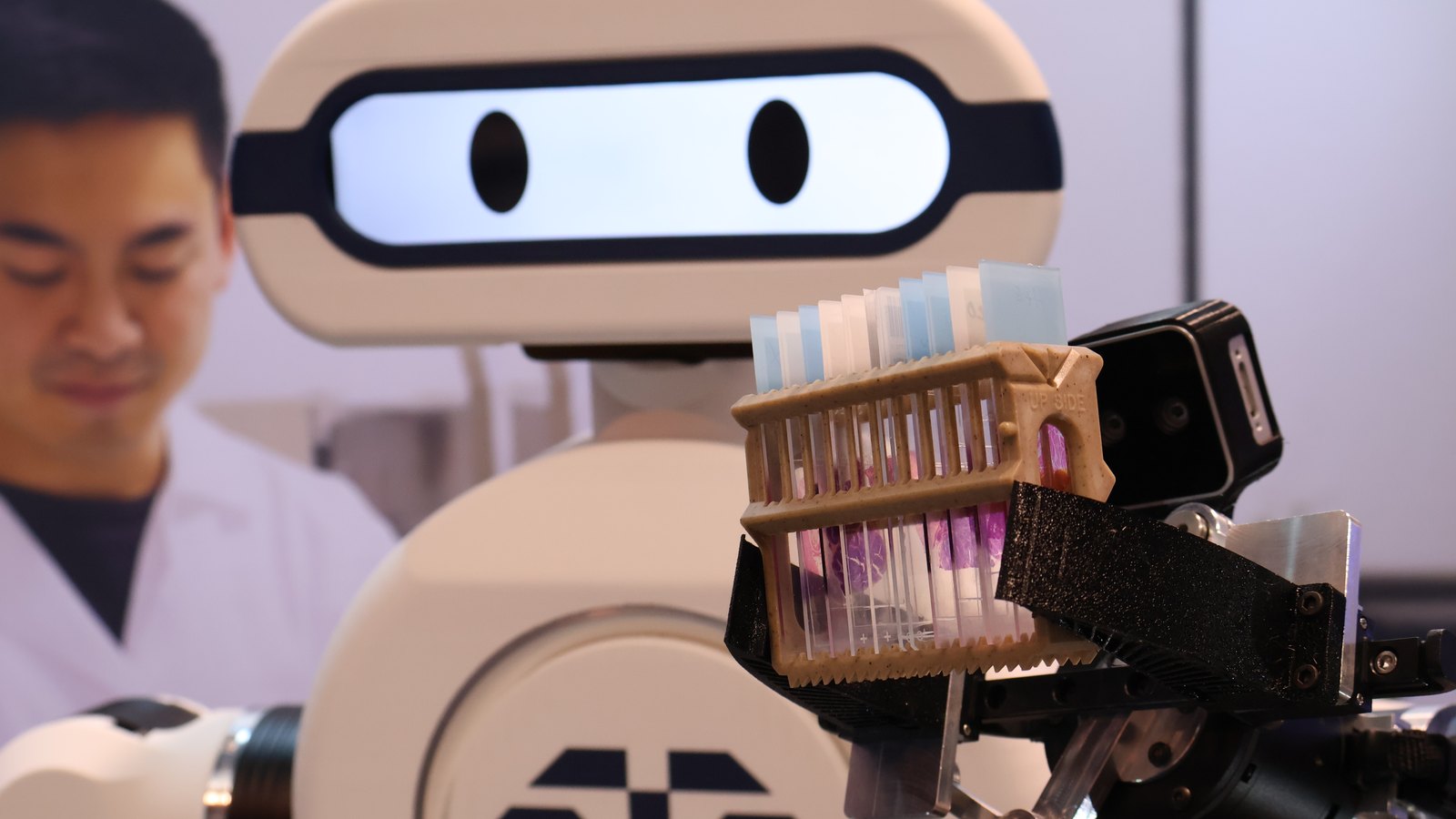
Our humanoid lab assistant has a name. She is Elsie by Tactus, and the name is inspired by a robot that came a long time before her.
In 1949, a neurophysiologist named W. Grey Walter built two small three-wheeled machines at the Burden Neurological Institute in Bristol. He called them tortoises. Their names were Elmer and Elsie, and ELSIE stood for Electromechanical robot, Light-SensitIvE.
Neither one was remote controlled, and neither was running a script. Elsie had a photocell, a contact switch, a pair of motors and two vacuum tubes. That was the whole brain. She moved toward light, backed away from what she bumped into, and when her battery ran low she found her charging hutch and went home to it.
She is widely recognized as the first autonomous robot ever built. And she was built in a laboratory.
Why that mattered to us
Robotics was born in a lab. We are bringing her back.
That’s the reason the name stuck. We worked through a long list of potential names - many defensible, most forgettable. But Elsie came with a great story - and points directly at the kind of work she’ll be doing. She is able to sense her surroundings, decide what to do, and do it. Seventy-seven years on, and that’s still the hard part.
What Elsie does now
Elsie by Tactus is an autonomous humanoid lab assistant, built for the clinical laboratory bench.
She works with two arms at human-height benches, using the instruments and tools a lab already owns. She perceives through touch, force sensing, depth and machine vision. She moves through the lab on her own, monitors instruments, moves samples and consumables, runs tests against the laboratory’s own validated procedures, and logs every action she takes. There is more on how she fits into a working lab on the Tactus AI platform page.
Labs are not short on automation, they are short on hands. Most labs already own instruments that could run far more hours than they currently do, and what is missing is a trained operator to keep them running. Elsie takes on that repetitive physical work so the skilled people in the lab can stay on the work only they can do.
Nothing she does goes live until the laboratory’s own quality team signs off on it.
Two Elsies
Walter’s Elsie navigated by light and found her way back to her charger. Ours navigates a working clinical laboratory and finds her way through a validated protocol.
The distance between those two things is most of the history of robotics. The idea underneath them is identical: build a machine that can work on its own, in the real world, with nobody holding the controls.
Elsie makes her public debut next week at ADLM 2026 in Anaheim, at booth 2616.
If you would like to see her work in your lab, get in touch.