
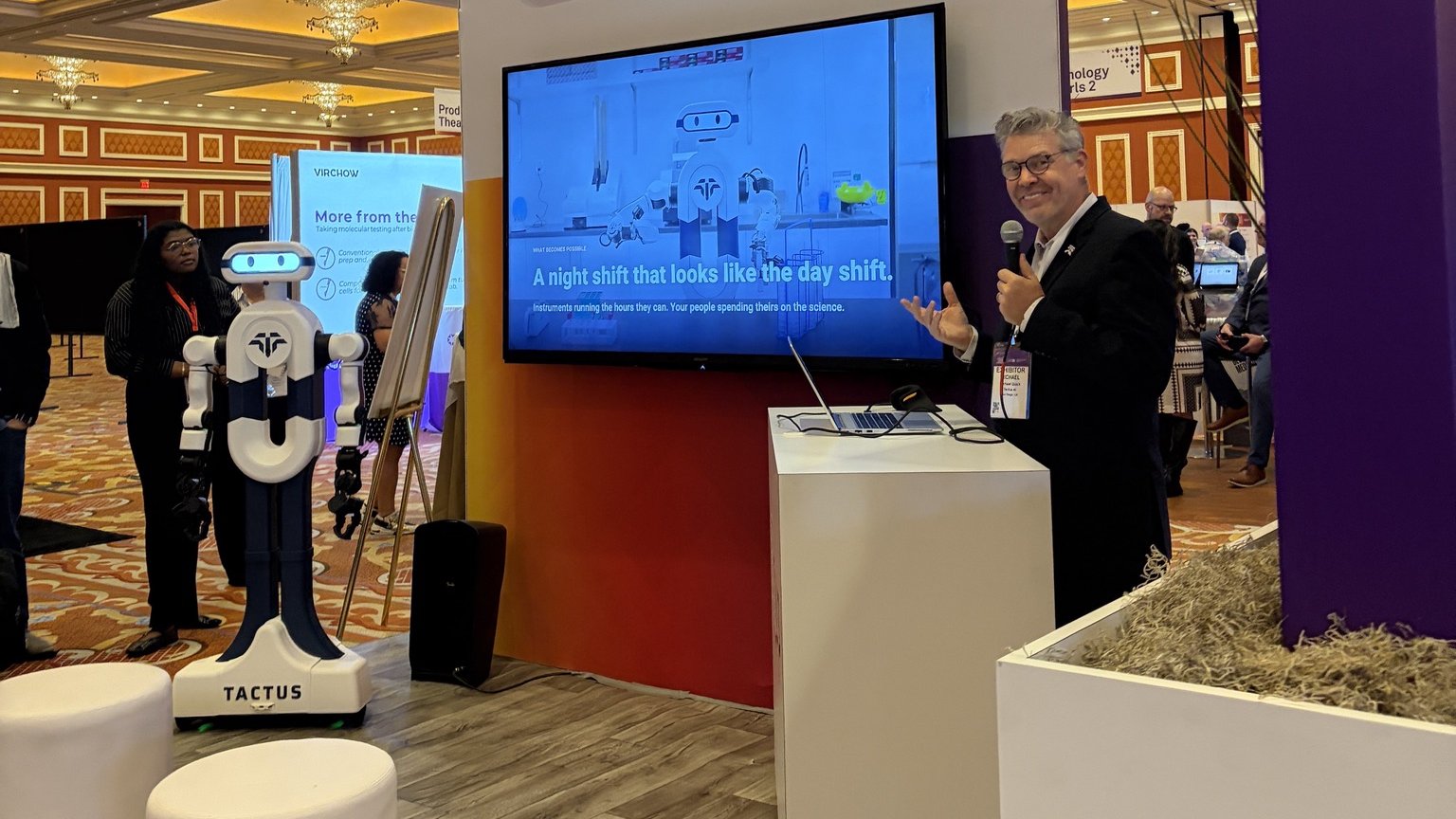
By Michael Quick, Chief Commercial Officer
There’s a moment I’ve watched over and over this year, and it never gets old.
Someone walks up to Elsie for the first time. They smile first. Then, about three seconds later, the scientist in them takes over, and the questions start.
That moment played out all weekend at CAP26, the College of American Pathologists annual meeting, October 3 to 5 at the Wynn in Las Vegas. It was Elsie’s first CAP, and it was one of the best rooms we’ve been in all year.
Twenty-five minutes, one question
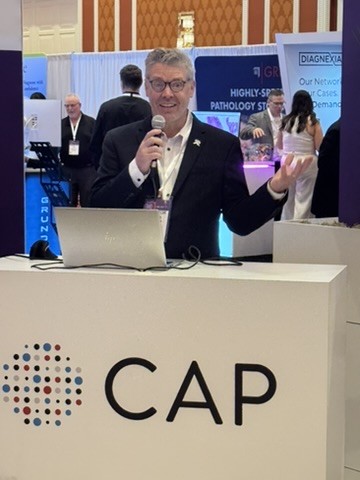
On Saturday afternoon I had the privilege of speaking at the CAP26 Innovation Hub, during the opening reception of the exhibit hall. The talk was called “Humanoid Robots in the Pathology Lab: Where They Fit, and What It Takes to Trust Them,” and I shared the stage with a colleague who stole the show. Elsie stood beside me the whole time.
Everything in the talk was built around one question: is your lab robot-ready?
We opened with the past year’s humanoid blooper reel, because the field has earned a little laughter. Robots tumbled at a half marathon start line, at a weightlifting competition and in the middle of a stage debut. Then we turned to the bench, where the stakes are a rack of glass slides or blood tubes and a patient behind every one of them.
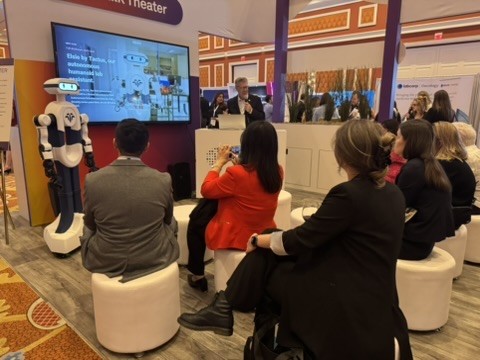 The Tech Talk Theater at the opening reception, Saturday, October 3.
From there, three ideas carried the talk.
Every layer of automation solved something real. Analyzers took on the analytical work. Total laboratory automation took the high-volume tube flow of the core lab. Digital pathology and AI changed what we can see and how fast we can share it. What remains is the physical work between the instruments: loading, unloading, carrying, tending. That’s the work humanoids are built for, at human bench height, with human tools, on the instruments a lab already runs.
The work is growing faster than the people. The U.S. Bureau of Labor Statistics projects more than 20,000 openings for clinical laboratory technologists and technicians every year through 2035. ASCP’s 2024 vacancy survey put anatomic pathology at the highest vacancy rate of any lab department it measured, up to 28.5 percent. When I asked the room to raise their hands (or a glass) if their lab was short-staffed, nearly every hand went up.
Trust is built, not assumed. A robot earns a place at the bench the same way a new instrument does: one validated workflow at a time, with every handling step logged against the specimen, staff owning the result, and the lab’s own QA signing off. We closed with a number of questions any lab can ask of any robot, and four things good looks like on inspection day. Show me the scope. Show me the log. Show me who signed. Show me what happens when it stops.
What people asked us
The best part of any show is what you learn, and CAP26 taught us a lot.
At the booth, three themes came up again and again.
Staffing came first. When we asked visitors to name their biggest pain, staffing led by a wide margin. People didn’t describe it in the abstract. They described benches they can’t cover and skilled people stretched across too many tasks.
The handoffs between instruments. One lab leader pointed us to a place we keep hearing about: the moment a specimen arrives and has to get from receiving to the instrument. It’s exactly the kind of physical, repetitive work in between that we’re building Elsie to take on.
Some had tried before. A couple of visitors told us about earlier attempts with carts and robotic arms that never quite worked in their labs. Those were some of the most valuable conversations of the week, and they reinforced something we believe deeply: a robot has to fit the lab as it is, not the other way around.
Up close and personal
Plenty of people at CAP had read about humanoid robots. Very few had stood next to one built for their lab.
That changes the conversation. Elsie is friendly by design, with eyes you can read and a wheeled base that keeps her steady and safe at the bench. People leaned in, took pictures, and asked how she learns a new instrument. (The short answer: thousands of practice runs in a digital twin of the real bench first, then side by side with staff, and only the lab’s QA can release a new skill.)
Watching pathologists and lab directors meet her up close, I came away more optimistic than ever. This community isn’t asking whether robots belong in the lab. It’s asking how to bring them in the right way, and that’s exactly the conversation we want to have.
What comes next
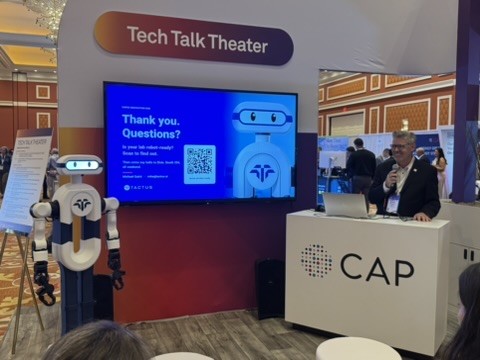
Thank you to the College of American Pathologists and the Innovation Hub team for the stage, and to everyone who stopped by Booth 354 to say hello. If we met in Las Vegas, we’ll be in touch soon.
Next week, I’ll be in Tempe for the ASU National Diagnostics Summit on October 14, joining the panel “Innovation in Lab Operations: What Does the Future Look Like?”
Then we come home. Pathology Visions, the Digital Pathology Association’s annual conference, runs October 16 to 18 at the Manchester Grand Hyatt in San Diego, and Elsie will be there. If you missed her in Las Vegas, this is your chance.
In the meantime, ask yourself the question from the talk. Is your lab robot-ready? Take the free Robot Readiness checklist and find out.